Portland vs. the rest of Oregon: why the same local SEO playbook gets different results
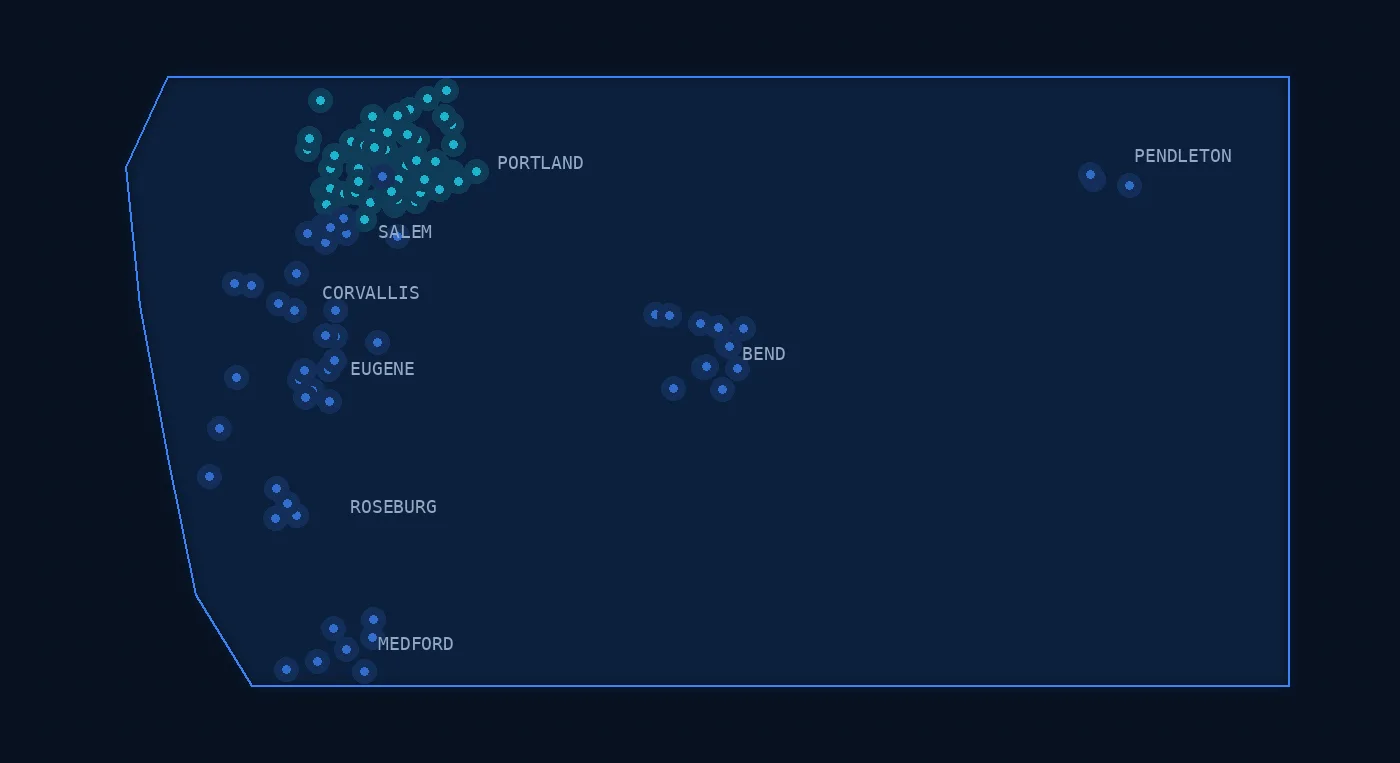
The short answer: Portland is a fight for position; the rest of Oregon is a race to be first to do the basics well. Same state, same Google, same AI assistants, but the thing standing between a home service business and its next customer is different in Gresham than it is in Grants Pass. If you run one playbook statewide, you'll overspend in the metro and underbuild everywhere else. I've watched both happen. Here's what actually changes and what to do about it.
Two markets that only look alike on a map
I live in Corvallis, which puts me about ninety minutes from Portland and about ninety minutes from the coast. That's a useful vantage point, because the local search results I see every day come from both worlds. In the Portland metro, a search for "emergency plumber" returns a map pack crowded with franchises, rollups backed by private equity, and lead gen sites that exist only to resell the call. Everyone in that pack has hundreds of reviews, a tuned Google Business Profile, and a content team. The question isn't whether the basics are done. They're done. The question is who did them better, suburb by suburb.
Drive south on I-5 and the picture inverts. In Salem, Eugene, Albany, Roseburg, Medford, and especially on the coast, the map pack is often held by businesses that haven't updated their profile since they claimed it. Categories are wrong or missing. Reviews trickle in a few a year. The website is a single page with a phone number and a stock photo of a van. The competitor who shows up with a structured local presence only has to be the first one who looks like the best operator in town to Google and to the AI assistants reading Google.
What changes, lever by lever
| Lever | Portland metro | Rest of Oregon |
|---|---|---|
| Map pack | Radius is tight. You rank where you're physically located or have a real presence; a Beaverton office doesn't carry you into Gresham. Wins come from review velocity, category precision, and highly specific services. | Radius is wide. A single well built profile can hold the pack across a whole town and its neighbors. Fixing categories and adding services often moves rankings within weeks. |
| Location pages | Suburb level pages (Tigard, Lake Oswego, Hillsboro) that prove you actually work there: neighborhoods, permit quirks, local projects. Generic city pages get ignored. | City pages across your drive time radius, built with real substance. Often nobody else has them, so even a solid page ranks. Coverage matters more than depth. |
| Reviews | Volume is table stakes; specificity and recency are the differentiators. A review that names the service and the suburb is worth more than five that say "great job." | Volume alone can flip a pack. Going from 12 reviews to 60 with a simple, consistent ask is frequently the single biggest lever available. |
| Content | Competitors already have service pages and blogs. You win by being more quotable and more specific, as the page an AI assistant cites. | A clear, plainly written service page is often the best written thing in the market. Answer the questions homeowners actually ask and you become the source. |
| AI answers | Assistants have plenty of candidates to choose from. Entity clarity and corroboration decide who gets named; inconsistent data disqualifies you quietly. | Assistants frequently have no confident answer for a trade in a smaller town. The first business with clean structured data and consistent citations becomes the default recommendation. |
| Budget shape | Ongoing. Rankings are contested monthly and require continuous review, content, and technical work to hold. | Front loaded. A focused build over a few months creates a position that's relatively inexpensive to maintain. |
The Portland problem: everyone has done the work
When I audit a Portland area contractor, the fix list rarely contains "claim your profile" or "add your services." It contains things like: your primary category is Plumber when you do 60% of your revenue in water heater installation and the pack for that query is won by businesses using the more specific category; your reviews mention "Portland" constantly but never "Beaverton," where your shop actually is; your Tigard page is a copy of your Hillsboro page with the city name swapped, and Google has indexed exactly one of them.
The metro rewards precision. That means one GBP strategy per location with categories chosen by revenue. It means location pages that could only have been written by someone who works there: the specific neighborhoods, the older housing stock in Southeast versus the newer developments in Happy Valley, the permit process in Washington County versus Multnomah. And it means a review program that deliberately asks customers to mention what was done and where, because that language is what both Google and the AI assistants use to match a business to a query.
It also means accepting that Portland is a market you hold rather than take. You don't win it once. You win it this month, and then you win it again.
The rest of Oregon opportunity: nobody has done the work
Outside the metro, the audit looks different. The fix list is longer and the fixes are simpler. I'll find a roofer in Eugene with no secondary categories, a pest company in Salem whose address on Yelp doesn't match the one on Google, an HVAC contractor in Bend with one service area page for a territory that spans Redmond, Sisters, Sunriver, and La Pine. The website has no schema at all. The last review was posted eight months ago.
This is where structured local SEO pays back fastest, because the competition isn't structured. Consistent name, address, and phone everywhere. Proper LocalBusiness schema on a site that loads quickly on a phone. A city page for every town inside the real service area, each with actual substance: the services offered there, the jobs done there, what's different about the housing or the climate or the water. A review ask that happens on every completed job. These are the basics done completely, and in most Oregon markets, done completely is enough to take the pack.
The trap here is the opposite of Portland's: it's complacency. Bend is the clearest example. Five years ago it behaved like any midsized Oregon city. Today it's getting more contested every season as the population grows and metro style competitors move in. The businesses that built their local presence early are holding; the ones that waited are now fighting a Portland style battle without a Portland style head start. Medford and the Rogue Valley are on a similar, slower curve. Salem, sitting in Portland's commuter shadow, is starting to see metro competitors expand their service areas south.
The AI layer changes the math everywhere, but differently
When a homeowner asks ChatGPT or Gemini "who's a good electrician in Beaverton," the assistant doesn't return ten links. It names one or two businesses, drawn from what it can clearly identify, verify across sources, and quote. In Portland, the assistant has dozens of plausible candidates, so the deciding factor is entity clarity: the business whose name, address, services, and reputation are consistent everywhere the model looks is the one that gets named. Small inconsistencies that Google tolerates will get you silently dropped from an AI answer.
In smaller Oregon markets, I regularly see assistants hedge or give a generic answer because they don't have a confident pick. That's an open door. The first business in town with clean structured data, corroborated citations, and a page that plainly says who they are and what they do becomes the default recommendation, sometimes for a long time. I benchmark this monthly with a fixed panel of queries across ChatGPT, Gemini, and Google's AI Overviews, and the pattern is consistent: in uncontested markets, AI visibility is there for the taking.
How I'd budget it, by market
- Portland metro. Plan for an ongoing program. Front load the fixes (category strategy, entity cleanup, suburb pages that actually differ), then commit to a steady cadence of reviews, content, and technical maintenance. Expect movement in the pack within a couple of months and organic gains over six or more. You're paying to hold a position, and that's the honest cost of a market this valuable.
- Salem, Eugene, Corvallis, Albany, Medford. Plan for a focused build. Three to four months of concentrated work on GBP, schema, city pages, and a review system typically establishes a position that costs far less to maintain. Start now, because these markets are slowly getting more contested.
- Bend. Treat it as a metro in progress. Build like a smaller market but maintain like Portland. The window for cheap wins is closing.
- The coast and rural Oregon. Plan for coverage. Search volume is spread across dozens of small towns, so the win is a clean city page architecture across your entire drive time radius plus a GBP that accurately reflects the service area. One great page won't do it; twenty solid ones will.
Common questions
I'm in a Portland suburb. Should I target "Portland" or my actual city? Your actual city first. Google's map pack is location sensitive enough that a Tigard business is rarely going to win a Portland proper query over businesses located there, but it can dominate Tigard, Tualatin, and King City. Own your real territory, then expand with substantive pages for adjacent suburbs you actually serve.
How many city pages does a service area business in Oregon need? One for every town where you genuinely take jobs and where there's meaningful search demand, usually somewhere between five and twenty five. Each one needs real content. If you can't say anything specific about working in a town, you probably shouldn't have a page for it yet.
Can a small town Oregon business get recommended by ChatGPT? Often more easily than a Portland one. Assistants frequently lack a confident answer for trades in smaller markets. A business with consistent data across Google, directories, and its own site, plus proper schema and a few dozen specific reviews, can become the default recommendation.
Is local SEO in Portland still worth it given the competition? Yes, because the job values are high and the volume is real. It just requires a different posture: precision over coverage, continuous investment over a one time build, and an honest expectation that you're paying to hold ground, not just to take it.
This is the market reality behind my Oregon local SEO work. For what happens when city pages are copied instead of written, read why garage door city pages don't rank, which uses numbers from a real audit. If you'd like to know which side of this line your business is on, and what the assistants say when someone asks about your trade in your town, that's a 30 minute call.